
 Hybrid Bamboo Pillow
 Memory Foam Bamboo Pillow
 Kids Memory Foam Bamboo Pillow
 Baby Memory Foam Bamboo Pillow
 Panda Cloud Duvet
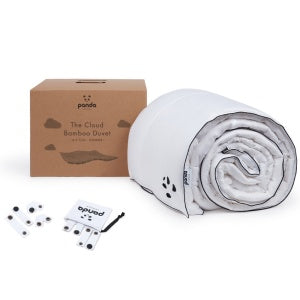 Bamboo Summer Duvet
 Kids Cloud Duvet
![[MattressTopper] Bamboo_Mattress_Topper_Package_Box-updated](http://pandalondon.com/cdn/shop/files/Bamboo_Mattress_Topper_Package_Box-updated.webp?crop=region&crop_height=1315&crop_left=92&crop_top=0&crop_width=1315&v=1782726992&width=1500)
![[MattressTopper] Woman laying on a Panda Bamboo Mattress Topper](http://pandalondon.com/cdn/shop/files/Bamboo_Mattress_Topper_Product_Image_01.webp?v=1782726484&width=1080)
![[MattressTopper] Guy laying on a Panda Bamboo Mattress Topper](http://pandalondon.com/cdn/shop/files/Bamboo_Mattress_Topper_Product_Image_02.webp?v=1782726484&width=1080)
![[MattressTopper] Woman setting up a Panda Bamboo Mattress Topper](http://pandalondon.com/cdn/shop/files/Bamboo_Mattress_Topper_Product_Image_03.webp?v=1782726484&width=1080)
![[MattressTopper] Panda London Memory Foam Bamboo Mattress Topper side](http://pandalondon.com/cdn/shop/files/Mattress_Topper_Isolated_-_resized.jpg?v=1773853354&width=800)
![[HybridMattressPro] Hybrid_Bamboo_Mattress_Pro_Product_Image_2026](http://pandalondon.com/cdn/shop/files/Hybrid_Bamboo_Mattress_Pro_Product_Image_2026.webp?v=1764944771&width=1000)
![[HybridMattressPro] A woman in white pajamas lies on her side on a mattress atop a gray upholstered bed frame in a softly lit bedroom. The mattress has a white top layer with a subtle geometric pattern and a black center band, with a small Panda Mattress logo patch visible on the side.](http://pandalondon.com/cdn/shop/files/Mattress_PRO-01.webp?v=1790672728&width=2049)
![[HybridMattressPro] Hybrid Bamboo Mattress Pro Cover Zip](http://pandalondon.com/cdn/shop/files/Hybrid_Bamboo_Mattress_Cover.jpg?v=1764944771&width=800)
![[HybridMattressPro] A woman in a cream-colored pajama set kneels beside a bed, holding down a mattress protector on a Panda Mattress to show its support and comfort.](http://pandalondon.com/cdn/shop/files/Mattress_PRO-03.webp?v=1790672728&width=2049)
![[HybridMattressPro] A woman in light pink pajamas sits on a Panda Bamboo mattress](http://pandalondon.com/cdn/shop/files/Mattress_PRO-04.webp?v=1790672728&width=2049)
![[CloudDuvet] Panda London The Cloud Bamboo Duvet Packaging](http://pandalondon.com/cdn/shop/products/Panda-London-The-Cloud-Bamboo-Duvet-Panda-Life-scaled_00a651ad-4ca3-4105-b520-12a94c1a4f71.jpg?v=1713363286&width=1920)
![[CloudDuvet] Panda London The Cloud Bamboo Duvet Rolled](http://pandalondon.com/cdn/shop/products/Duvet-Listing-Images03.jpg?v=1764079307&width=1000)
![[CloudDuvet] Guy making the bed with Panda Cloud Duvet 10.5 TOG](http://pandalondon.com/cdn/shop/files/Duvet_10.5_Tog-02.webp?v=1790607319&width=2049)
![[CloudDuvet] Guy reading a book on the bed covered with Panda Cloud Duvet 10.5 TOG](http://pandalondon.com/cdn/shop/files/Duvet_10.5_Tog-03.webp?v=1790607319&width=2049)
![[CloudDuvet] Guy making his bed with Panda Cloud Duvet 10.5 TOG](http://pandalondon.com/cdn/shop/files/Duvet_10.5_Tog-04.webp?v=1790607319&width=2049)
![[BBWhite] 100_Bamboo_Bedding_Set_Pure_White](http://pandalondon.com/cdn/shop/files/100_Bamboo_Bedding_Set_Pure_White_01.webp?v=1781082973&width=1080)
![[BBWhite] White 100% Bamboo Bedding Texture](http://pandalondon.com/cdn/shop/files/100_Bamboo_Bedding_-_Pure_White_-_Close_Up_02.webp?v=1773611287&width=1000)
![[BBWhite] 100_Bamboo_Bedding_Set_Pure_White couple laughing](http://pandalondon.com/cdn/shop/files/100_Bamboo_Bedding_Set_Pure_White_02.webp?v=1781082974&width=1080)
![[BBWhite] White 100% Bamboo Bedding Woman Duvet cover buttons](http://pandalondon.com/cdn/shop/files/hand_and_buttons_1.webp?v=1773611287&width=1000)
![[BBWhite] 100_Bamboo_Bedding_Set_Pure_White woman sleeping](http://pandalondon.com/cdn/shop/files/100_Bamboo_Bedding_Set_Pure_White_03.webp?v=1781082973&width=1080)
![[BBUrbanGrey] 100_Bamboo_Bedding_Set_Urban_Grey_guy laying on the bedding](http://pandalondon.com/cdn/shop/files/100_Bamboo_Bedding_Set_Urban_Grey_01.webp?v=1781083567&width=1080)
![[BBUrbanGrey] Cloud Duvet Urban Grey 100% Bamboo Bedding Set](http://pandalondon.com/cdn/shop/files/Cloud_Duvet_-_Grey_-_Close_up_2.webp?v=1773611287&width=1000)
![[BBUrbanGrey] 100_Bamboo_Bedding_Set_Urban_Grey_woman opening the bedding bag](http://pandalondon.com/cdn/shop/files/100_Bamboo_Bedding_Set_Urban_Grey_02.webp?v=1781083568&width=1080)
![[BBUrbanGrey] 100_Bamboo_Bedding_Set_Urban_Grey_woman making the bed](http://pandalondon.com/cdn/shop/files/100_Bamboo_Bedding_Set_Urban_Grey_04.webp?v=1781083567&width=1080)
![[BBUrbanGrey] 100_Bamboo_Bedding_Set_Urban_Grey_couple reading magazines](http://pandalondon.com/cdn/shop/files/100_Bamboo_Bedding_Set_Urban_Grey_03.webp?v=1781083567&width=1080)
![[BBNavyBlue] Deep Sea Navy Blue 100% Bamboo Bedding Set couple reading a magazine](http://pandalondon.com/cdn/shop/files/100_Bamboo_Bedding_Set_Deep_Sea_Navy_01.webp?v=1781083134&width=1080)
![[BBNavyBlue] Deep Sea Navy Blue 100% Bamboo Bedding Texture](http://pandalondon.com/cdn/shop/files/Cloud_Duvet_-_Navy_-_Close_up_2.webp?v=1773611287&width=1000)
![[BBNavyBlue] Deep Sea Navy Blue 100% Bamboo Bedding Set couple reading a magazine and smiling](http://pandalondon.com/cdn/shop/files/100_Bamboo_Bedding_Set_Deep_Sea_Navy_02.webp?v=1781083135&width=1080)
![[BBNavyBlue] Deep Sea Navy Blue 100% Bamboo Bedding Set woman resting](http://pandalondon.com/cdn/shop/files/100_Bamboo_Bedding_Set_Deep_Sea_Navy_04.png?v=1781083138&width=1080)
![[BBNavyBlue] Deep Sea Navy Blue 100% Bamboo Bedding Set guy laying and smiling](http://pandalondon.com/cdn/shop/files/100_Bamboo_Bedding_Set_Deep_Sea_Navy_03.webp?v=1781083134&width=1080)
![[BBPink] Vintage Pink Blue 100% Bamboo Bedding woman making the bed](http://pandalondon.com/cdn/shop/files/100_Bamboo_Bedding_Set_Pink_01.webp?v=1781083678&width=1080)
![[BBPink] Vintage Pink Texture 100% Bamboo Bedding](http://pandalondon.com/cdn/shop/files/Cloud_Duvet_-_Pink_-_Close_up_2.webp?v=1773611287&width=1000)
![[BBPink] Vintage Pink Blue 100% Bamboo Bedding woman hugging the pillow with vintage pink pillow case](http://pandalondon.com/cdn/shop/files/100_Bamboo_Bedding_Set_Pink_02.webp?v=1781083678&width=1080)
![[BBPink] Vintage Pink Blue 100% Bamboo Bedding woman hiding under duvet with pink duvet cover](http://pandalondon.com/cdn/shop/files/100_Bamboo_Bedding_Set_Pink_03.webp?v=1781083679&width=1080)
![[BBPink] Vintage Pink Blue 100% Bamboo Bedding woman laying and smiling on the panda bedding set](http://pandalondon.com/cdn/shop/files/100_Bamboo_Bedding_Set_Pink_04.webp?v=1781083679&width=1080)
![[BBGrey] 100_Bamboo_Bedding_Set_Quiet_Grey_ woman holding the bedding](http://pandalondon.com/cdn/shop/files/100_Bamboo_Bedding_Set_Quiet_Grey_01.webp?v=1781083287&width=1080)
![[BBGrey] Light Grey 100% Bamboo Bedding texture](http://pandalondon.com/cdn/shop/files/Texture17.webp?v=1773611287&width=1000)
![[BBGrey] 100_Bamboo_Bedding_Set_Quiet_Grey_0guy laying and smiling](http://pandalondon.com/cdn/shop/files/100_Bamboo_Bedding_Set_Quiet_Grey_02.webp?v=1781083287&width=1080)
![[BBGrey] 100_Bamboo_Bedding_Set_Quiet_Grey_0guy reading a magazine on the bed](http://pandalondon.com/cdn/shop/files/100_Bamboo_Bedding_Set_Quiet_Grey_03.webp?v=1781083287&width=1080)
![[BBGrey] 100_Bamboo_Bedding_Set_Quiet_Grey_0woman making the bed](http://pandalondon.com/cdn/shop/files/100_Bamboo_Bedding_Set_Quiet_Grey_04.webp?v=1781083287&width=1080)

Quick Answer:
The clocks go back on the last Sunday in October — 25 October this year — at 2 am, when the time returns to 1 am. You gain an hour in bed, but that doesn't reliably mean more sleep: your body clock still has to catch up with the one on the wall. Most people settle within a few days, and the quickest way through it is to keep your wake time consistent and get outside in the morning light.
There's one Sunday a year when you're handed an extra hour in bed, and it ought to feel like a win. Then Monday arrives. You're awake before your alarm, it's dark by half past four, and the whole thing feels less like a gift than an ambush.
Gaining an hour is the easier of the two clock changes — losing one in spring is harder on most people. But easier isn't the same as easy. Your body doesn't keep time by looking at a clock, so for a few days it carries on running to the old schedule while the rest of the country has moved on. Here's what's actually going on, and what to do about it in the week before and the week after.
When do the clocks change?
In the UK, the clocks go back on the last Sunday in October and forward again on the last Sunday in March. This year, that's Sunday 25 October 2026.
The change happens at 2 am, when the clocks go back to 1 am — which is why it lands in the small hours of a Sunday, when the fewest people have to live through the same hour twice.
|
Year |
Clocks forward |
Clocks back |
|
2026 |
29 March 2026 |
25 October 2026 |
|
2027 |
28 March 2027 |
31 October 2027 |
|
2028 |
26 March 2028 |
29 October 2028 |
If you've ever had to stop and think about which way they go, the old line still does the job: spring forward, autumn back. Your phone, laptop and smart speaker will update themselves. The oven, the car and the clock in the hall generally won't.
What the clock change does to your sleep
Your body runs on an internal clock — a roughly 24-hour cycle that decides when you feel alert and when you start winding down. It takes its cues mainly from light, not from the numbers on your phone. So when an hour vanishes from the calendar overnight, your internal timing doesn't move with it.
In October, that usually shows up as early waking. If you normally surface at seven, your body still thinks seven arrives when the clock says six. Bedtime feels late. Meals land at odd moments. Your energy dips at times it didn't last week. For most people, it settles within a few days.
It is the gentler of the two changes, for what that's worth. Losing an hour in spring asks your body to fall asleep before it feels ready, which is a harder thing to negotiate than waking up earlier than you meant to.
The darker evenings pile on top of all this, but that's a separate effect with its own biology. We've gone into the science of autumn tiredness properly in Why You Might Be Feeling Sleepier in Autumn, and if the darker months tend to flatten your mood rather than just your energy, our guide to seasonal affective disorder is the better place to start.
How to prepare: the week before, and the week after
You can do nothing at all and let your body work it out, and plenty of people do exactly that. But if the clock change usually knocks you sideways, a week of small adjustments makes a real difference.
The week before: shift in small steps
Push your bedtime 15 to 20 minutes later every second night, starting about a week out. By Saturday you'll be going to bed roughly an hour later than usual — which is precisely where the new clock wants you. Move your evening meal with it if you can; your digestion is part of the same rhythm.
Keep your wake time anchored
This matters more than bedtime, and it's the part most people skip. A consistent wake time is the strongest cue your body clock has. If you shift everything else but let your mornings drift, you'll spend longer unsettled.
The Sunday itself
Get up at your normal clock time rather than taking the lie-in. It feels like wasting the free hour, we know. But one long morning in bed is the quickest way to turn a one-day adjustment into a week-long one.
The few days after
Get outside in the morning, ideally within an hour or two of waking. Daylight early in the day is the single most effective way to tell your body clock where it now stands. Twenty minutes helps; a walk to the station counts.
Setting up your bedroom for the darker months
The clock change rarely arrives alone. It tends to land in the same week the heating goes on and the evenings turn properly dark, which means your bedroom conditions shift at exactly the moment your sleep is already unsettled. It's worth a few minutes' attention.
Bedding and warmth
Once the heating is on, bedrooms often run warmer than they did a fortnight earlier — so a heavier duvet isn't automatically the right answer. If your room is genuinely cold, a 10.5 tog is the usual year-round choice and 13.5 or 15 tog suits a draughty room. If the heating is doing the work, you may be better off staying where you are. Our duvet tog rating guide walks through how to pick.
Breathability matters more than most people expect at this time of year. Bamboo is naturally thermoregulating and moisture-wicking, which helps when the room is warmer than your body wants it — the Cloud Bamboo Duvet is built around that, and there's more in the full duvet range.
Light
Darker evenings and mornings that feel lighter on the new clock. If early light is pulling you awake before you're ready, a bamboo eye mask is the simplest fix going — we've covered why they work elsewhere. At the other end, a wake-up light that brightens gradually can take some of the shock out of getting up in the dark.
Temperature
A cool room is easier to sleep in than a warm one, and the usual advice of somewhere around 16 to 18°C holds whatever the clocks are doing. If you run hot at night and the heating has made that worse, our hot sleepers guide goes further.
Habits that help
Caffeine is the one worth watching. It's tempting to lean on it harder as the mornings get darker, but it lingers for longer than most people assume — a mid-afternoon coffee can still be in your system at bedtime. Keep it to the morning while your sleep is resettling.
Morning daylight is the other half of the same job, and it's free. A short walk before work does more for your body clock than almost anything you can buy.
Beyond that, the ordinary things still apply: a consistent wind-down, screens off a while before bed, and nothing heavy to eat late. None of it is new advice. It's just more useful than usual in the fortnight after the clocks move.
What about the spring clock change?
The same approach works in reverse, and you'll need it more. Losing an hour in late March is generally the harder of the two changes, because you're asking your body to fall asleep before it feels ready rather than simply waking early.
Shift bedtime earlier by 15 to 20 minutes every second night in the week before, hold your wake time steady, and get morning light. The hour you lose in spring is the one your body argues about.
Why do we have daylight saving at all?
The idea is to make better use of the natural light we get — shifting an hour of daylight from the early morning, when most people are asleep, to the evening, when they aren't.
The British version has an unlikely origin. William Willett, a builder from Chislehurst, was out riding one summer morning in the 1900s and noticed how many blinds were still down. In 1907, he self-published a pamphlet called The Waste of Daylight, arguing the country should move its clocks. He campaigned for the rest of his life and died in 1915 — the year before Parliament finally passed the bill. British clocks went forward for the first time on 21 May 1916.
Germany had got there a few weeks earlier, adopting it nationally in 1916 as a wartime measure to save coal. Today around 70 countries use daylight saving — roughly a third of the world, and fewer than most people assume.
Have a wonderful Autumn
FAQ
1. When do the clocks go back?
In the UK, the clocks go back on the last Sunday in October, which is Sunday 25 October 2026. They change at 2 am, when the time returns to 1 am.
2. Do you gain or lose an hour when the clocks go back?
You gain one. The clocks move from 2 am back to 1 am, so the night is an hour longer. In spring, the opposite happens, and you lose an hour.
3. Can DST impact the quality of sleep?
Yes, it can. The abrupt change can lead to shorter and lower-quality sleep, as the body may still adjust to the new schedule. Some individuals may experience sleep disturbances, such as insomnia or restlessness.
3. Why am I still tired when I gained an hour?
Because your body clock runs on light, not on the time displayed on your phone. It takes a few days to catch up, so your sleep, appetite and energy sit slightly out of step with the day in the meantime.
4. How long does it take to adjust to the clock change?
Most people settle within a few days. Some take closer to a week, particularly if their sleep was already irregular. Keeping a consistent wake time tends to shorten it.
5. How can I prepare for the clocks going back?
Shift your bedtime 15 to 20 minutes later every second night during the week before, keep your wake time fixed, and get outside in the morning once the change has happened.
6. Is the spring or autumn clock change harder?
Spring is generally harder. Losing an hour means going to bed before your body is ready, which is more difficult than waking early — the usual autumn complaint.
![[MemoryFoamPillow] Panda Luxury Memory Foam Bamboo product image](http://pandalondon.com/cdn/shop/products/Panda-Memory-Foam-Bamboo-Pillow-Panda-Life-scaled-e1623788835840.jpg?v=1771199183&width=800)
![[MemoryFoamPillow] Panda London Bamboo Memory Foam Pillow Girl Holding Pillow Lifestyle](http://pandalondon.com/cdn/shop/files/01_Memory_Foam_Bamboo_Pillow__alt04.jpg?v=1771199183&width=800)
![[MemoryFoamPillow] Panda London Bamboo Memory Foam Pillow](http://pandalondon.com/cdn/shop/files/03_Memory_Foam_Bamboo_Pillow__alt01.jpg?v=1771199183&width=800)
![[MemoryFoamPillow] Panda London Bamboo Memory Foam Pillow girl hugging the pillow](http://pandalondon.com/cdn/shop/files/02_Memory_Foam_Bamboo_Pillow__alt02.jpg?v=1771199183&width=800)
![[MemoryFoamPillow] Panda London Bamboo Memory Foam Pillow on a Panda Topper](http://pandalondon.com/cdn/shop/files/Memory-Foam-Bamboo-Pillow-on-Bed-Topper-and-Adjustable-Straps-Shown-Lifestyle-Square-768x768_png.webp?v=1771199183&width=768)
![[all] Bamboo Mattress Protector Package - PandaLondon](http://pandalondon.com/cdn/shop/files/Bamboo_Mattress_Protector_-_Packaging_Image_-_White_Background.webp?v=1721139172&width=1900)
![[all] Bamboo Mattress Protector for Hybrid Bamboo Mattress](http://pandalondon.com/cdn/shop/files/Bamboo_Mattress_Protector_New.webp?v=1721138562&width=1000)
![[all] Book on a Bamboo Mattress Protector](http://pandalondon.com/cdn/shop/products/Mattress-Protector-Listing-Images02.jpg?v=1721139189&width=1500)
![[all] Bamboo Mattress Protector Corner](http://pandalondon.com/cdn/shop/products/Mattress-Protector-Listing-Images03-e1623787734812.jpg?v=1721139189&width=1300)
![[all] Bamboo Mattress Protector Corner in line Panda London](http://pandalondon.com/cdn/shop/products/Mattress-Protector-Listing-Images04.jpg?v=1721139183&width=1500)
![[all] Panda Bamboo Mattress Protector Panda London](http://pandalondon.com/cdn/shop/files/Panda-Bamboo-Mattress-Protector-Guarantee-768x768_jpg_450393f5-91a9-499f-b15a-12d636a9a8b7.webp?v=1721139183&width=768)

